With Funding Cuts and Tax-Cap Proposals Ahead, Franklin County Residents Ask Leaders: What Is the Plan?

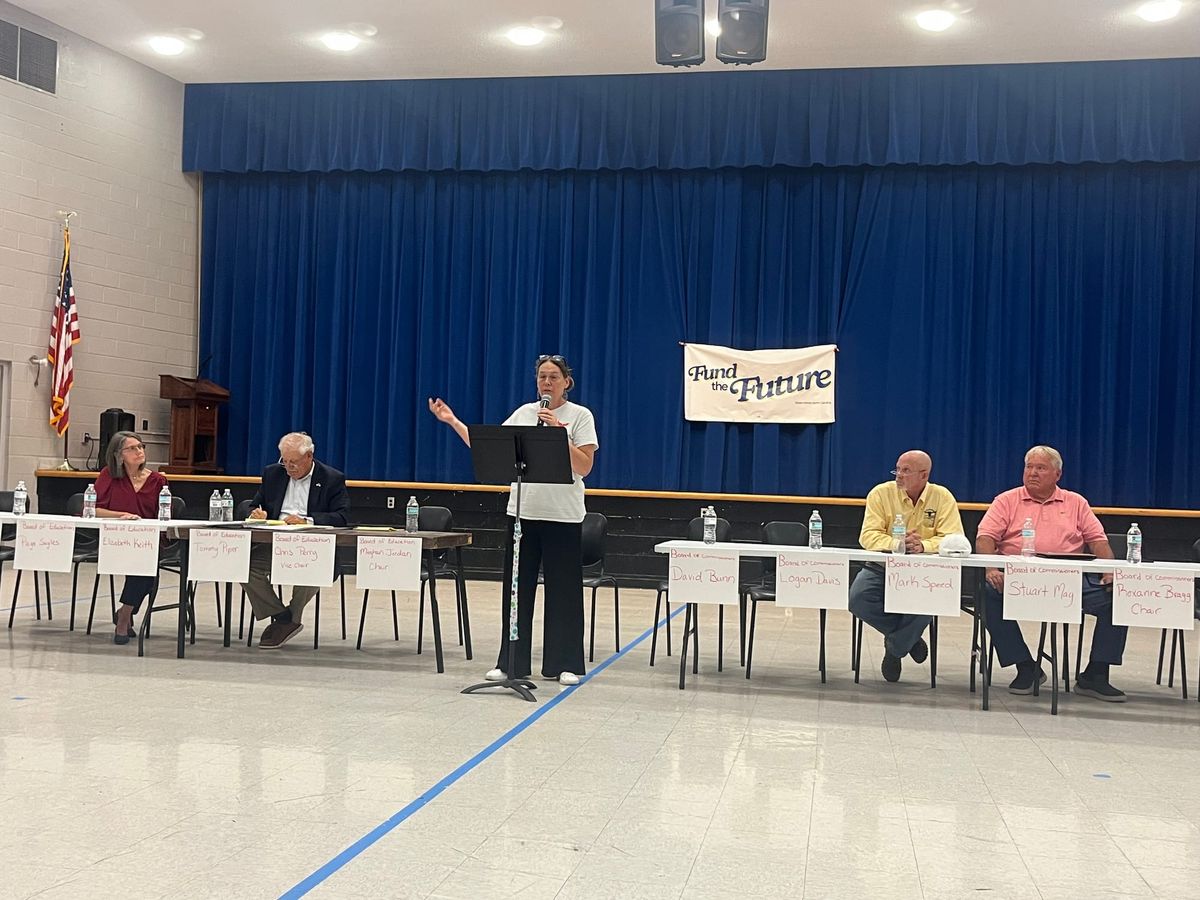
On October 11, Down Home Franklin County brought together residents and local leaders at Louisburg Magnet High School to ask a question many of us are looking for answers to: how will Franklin County protect essential services as communities face federal funding cuts and proposed state constitutional amendments?
The purpose of the town hall was to give residents an opportunity to explain what they were experiencing and how the proposed constitutional changes involving income taxes, property taxes and voter identification will affect them.
Who Attended, and Who Was Missing
Tania Kelly, a Down Home Franklin member and the event host, welcomed everyone and shared the purpose of the gathering.
“Today is about community members having the opportunity to speak directly to our elected officials, to the people that actually represent them,” Kelly said.
Invites were sent out to all of the Franklin County commissioners and school board members. However only 4 attended the Town Hall:
- County Commissioners Mark Speed and Stuart May
- School Board Members Paige Sayles and Tommy Piper.
What is the Plan?
Down Home member and former school board member Rosemary Champion spoke first, sharing her concern that the proposed amendments, combined with federal tax cuts passed as part of the Big Beautiful Bill, will lead to cuts to essential services in Franklin County.
“With these cuts already coming and our schools, healthcare systems, and families already under pressure, what specifically will you do to protect essential services in Franklin County? And if those services require additional resources, where do you propose that money come from?” she asked.
In response, Commissioner Speed talked about needing more partnerships with nonprofits, churches and other resources. School Board member Piper emphasized that the school board relies on federal, state and county funding and cannot levy taxes itself. School Board member Sayles described using grants and advocacy as a way to try to protect essential services students need, while Commissioner May said he supports and will serve his residents across party lines. None of the elected leaders present provided a concrete answer to Champion’s question.
A Mother Who Relies on Medicaid
Mary Richardson spoke next about what healthcare funding means to her family.
As a mother of four, she talked about receiving a cancer diagnosis while pregnant in 2021 and having to rely on Medicaid for continued treatment because her condition has made her unable to work. With the new work requirements for Medicaid, she is concerned she will not be able to get the care she needs to have a full life with her children.
“Emerald deserves a chance to grow up with her mother. My other children deserve that too. And every child in this county deserves a chance to grow up with a parent who can get the healthcare they need,” Richardson said.
She asked elected officials what they would do to protect residents’ access to care and help people understand changing requirements.
Commissioner Speed said he would advocate with state and federal officials and help her obtain information needed for paperwork. He also sits on the Board of Directors for Franklin County Social Services and promised to make sure she and others have access to resources to help them through the new process. Commissioner May expressed willingness to help residents access needed care. Neither commissioner addressed the burden that Medicaid work requirements place on people in Richardson’s position.
A Teacher Connecting Funding to Classrooms
The third speaker, local educator Tammy Petrosillo, connected funding concerns to classroom supplies, school meals, student therapies and replacing Franklinton Elementary School. She acknowledged the effort that both the commissioners and school board members have taken to secure a grant for Franklinton Elementary, but noted that they have applied many times before and have been denied. She recalled personal experience with budget cuts affecting her classroom as well.
“I have been in the classroom where my budget got cut so bad I could not order the basics, and I do have to say I went home and cried and panicked, and I very quickly learned how to write grants,” she said.
School Board member Paige Sayles replied
“We want to provide the best that we can for our kids, and we will have to continue to apply for different grants that are out there, to rely on the commissioners to go up to Raleigh to advocate for us, and we need to go up ourselves as well”
Housing Needs Brought a Request for Action
The fourth and final speaker was Beverly Kegley, director of The Franklin County Interfaith Council in Louisburg, NC. She talked about the work her organization does and how they help the community. She described helping families struggling with hunger and housing, including a working woman with cancer living in her vehicle.
“This woman, we wanted her to go to Vance County where she would be in a shelter, but she works. She works every day that she's able to in a nursing home. She takes care of her brother who is disabled and lives here in Franklin County. She was stopping 6 times a day to put air in the tires of her car. So she can stay on the road going to work and taking care of her brother,” Kegley said.
The council purchased tires, provided food and helped the woman seek safer places to park. But then reality set in.
Kegley said most of the council’s 10 partner pantries reported their numbers doubling over the three months. She also said about 167 students were identified under McKinney-Vento in 2022 and that number has risen to 246,a 47% increase. She asked the panelists:
“As these needs increase and the resources available decrease, what do you plan to do? How can you help us?”
In response, Commissioner May requested that she submit all her concerns and needs to him in writing while acknowledging the difficulty of addressing homelessness.
“A lot of people need help year-round. I don't know how to answer your question. I've talked to you about this before,” May said.
Commissioner Speed said he supports pursuing a shelter in Franklin County.
Now the Community Needs to Take Action.
“We've heard a lot of stories about healthcare; we've heard stories about education, food, and housing, and what is at stake. But this gathering is never just about hearing stories, it's about taking action,” Kelly said as the event came to an end.
For Franklin County residents, that means learning what the proposed changes would do, asking elected leaders questions and holding them accountable. The community deserves answers to the questions that were asked during this event, and we deserve to be part of the conversation when it comes to funding our communities.
By putting residents’ experiences directly before local leaders, Down Home Franklin put the conversation where it belongs as residents think about their choices in this year’s elections. Now it's up to us to continue those conversations and to make our voices heard on November 3rd.