
County Beacon Newsletter #17: You’re being asked to vote on amendments to the N.C. Constitution. Here’s what you need to know.
Part 1 of County Beacon's Guide to understanding the proposed amendments to the N.C. Constitution.


When you go to vote in the next few weeks, either by mail (happening now!), during early voting (Oct. 15 -31) or on Election Day (Tuesday, Nov. 3), you might be surprised to see a section called “Referenda” on your ballot.
There are three proposed amendments to the North Carolina Constitution that you can vote for or against. These questions may seem simple, but the impacts will be profound and likely permanent, so it’s important to understand what these amendments do before you vote.
That’s why today we’re introducing the first in a series of articles exploring the potential impacts and the arguments for and against these amendments. If you’ve got questions, we’d love to hear them. You can email us any time at countybeacon@beaconmedianc.org.
The first thing to understand is that when you choose for or against, you are not voting on a bill that lawmakers can change at any time. You are being asked to permanently change the North Carolina Constitution.
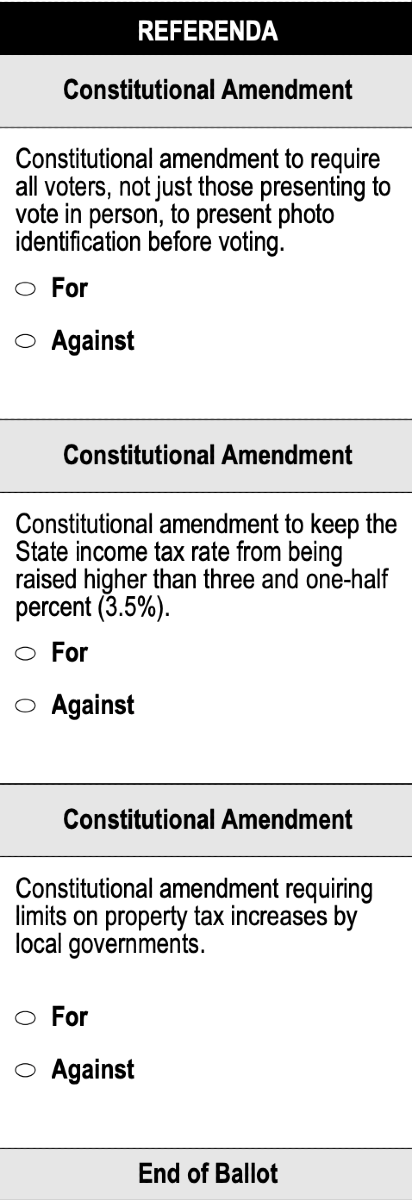
Here are the three Referenda as they will appear on your ballot:
Let’s take these one by one. You’ll notice we spend more time on the second and third amendments — this will also be the case for the rest of this series. That’s because the impacts of these amendments are harder to understand — and analysts believe they could have devastating impacts on NC’s local governments. So we want to make sure you consider all the angles. OK, so what do these amendments say, and what do they actually do?
Amendment 1: Update Voter ID Amendment
What you'll see on your ballot:
Constitutional amendment to require all voters, not just those presenting to vote in person, to present photo identification before voting.
[ ]For
[ ]Against
What it would do:
This amendment changes the language in our constitution to specify that all voters, not just those voting in person, have to show an approved form of photo ID.
What you need to know:
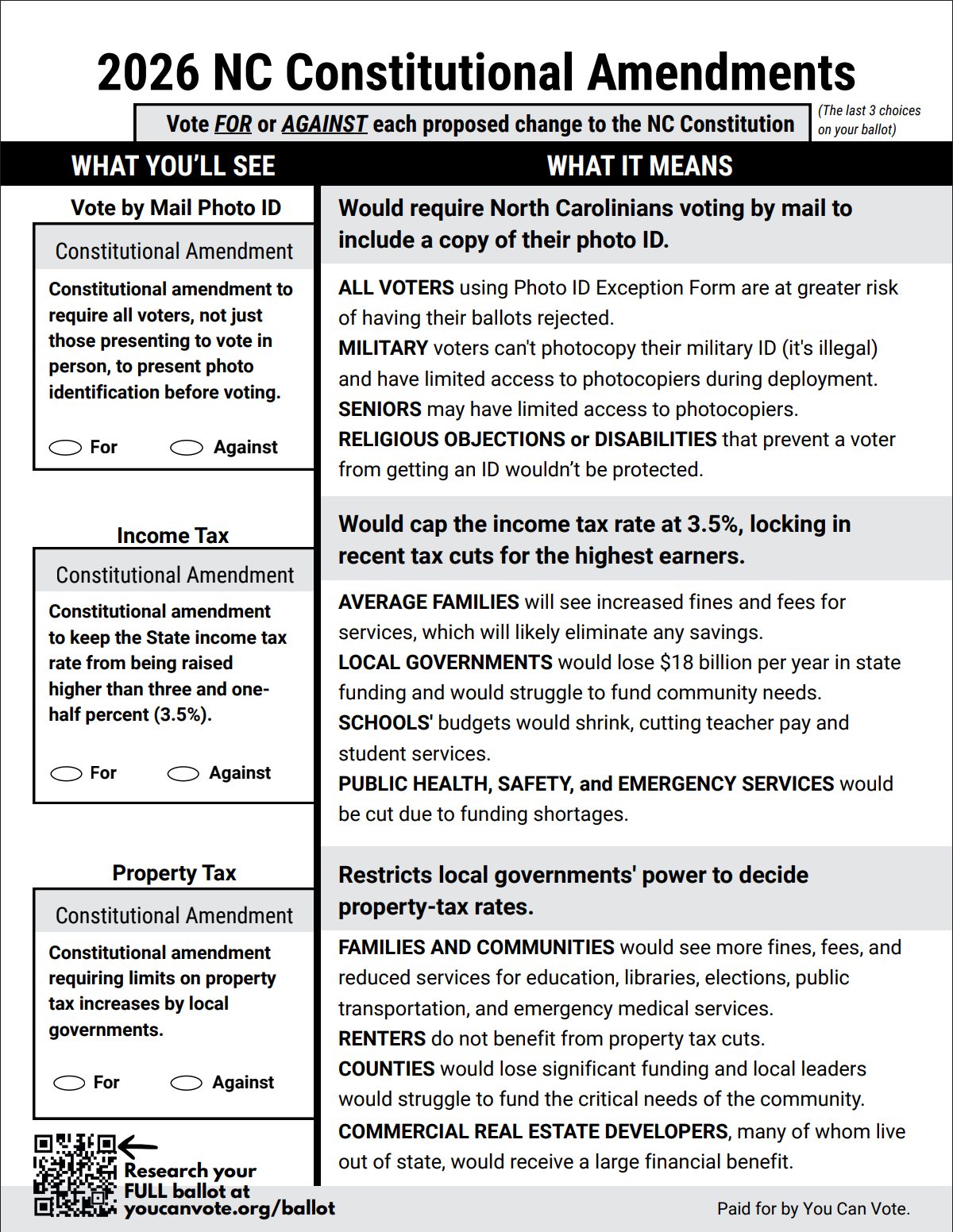
People who vote in person already have to show ID. Currently, people who vote by mail must include a copy of their ID or fill out an exception form. It’s unclear what this amendment would change, since the state board of elections decides the specific implementation rules. The concern is that qualified voters who make minor procedural mistakes or are unable to include photocopies of their ID could have their votes thrown out.
Amendment 2: Cap state income tax at 3.5%
What you'll see on your ballot:
Constitutional amendment to keep the State income tax rate from being raised higher than three and one-half percent (3.5%).
[ ] For
[ ] Against
What it would do:
If passed, this amendment would prevent future legislatures from raising the state income tax level above 3.5%. The new cap would take effect Jan. 1, 2027.
What you need to know:
Back in 2018, voters approved an amendment to reduce the state income tax cap from 10% to 7%. The state's personal income tax rate is currently 3.99%, already well below the existing cap. State law also contains revenue-based triggers that could lower the personal rate from 3.99% to 3.49%, then 2.99%, and eventually 2.49% if state revenues reach specified thresholds.
The proposed amendment applies to both personal and corporate income taxes. North Carolina's corporate income tax rate is already 2% and is scheduled under current law to fall to 1% in 2028 and 0% in 2030.
So basically you are not just voting to lower your current personal income tax rate from 3.99% to 3.5%.
You are also deciding whether the North Carolina Constitution itself should prevent future lawmakers from ever setting personal or corporate income tax rates above 3.5%. Budget analysts say the cuts would more dramatically affect rural counties.
Note: If the state's first revenue trigger is met as forecast, the personal income tax rate would already fall to 3.49% in 2027, below the proposed cap.
Amendment 3: Allow state legislature to limit local property taxes
What you’ll see on your ballot:
Constitutional amendment requiring limits on property tax increases by local governments.
[ ] For
[ ] Against
What it would do:
If this amendment passes, it would add this sentence to the North Carolina Constitution, per House Bill 1089, sponsored by Franklin County Sen. Lisa Barnes:
“The General Assembly shall enact general laws limiting the amount by which the levy of taxes on property may increase, which may include exceptions.”
What You Need To Know:
This amendment does not specify the formula for capping property taxes – it just gives the legislature the power to do that without any parameters. What will the limit be? What formula will they use to decide? Will it adjust for inflation or emergencies? What exceptions will be allowed? We don’t know.
You’re effectively being asked to take the power to decide property tax rates away from your local county commissioners and give it to the state legislature.
For more information, check out You Can Vote’s amendment guide and articles from the NC Budget and Tax Center here, here, and here. And stay tuned for part 2 of our series on how these amendments could impact your community!
This newsletter is a great way to keep up with Franklin and Granville counties. Forward this to a friend so they can sign up here!
-The County Beacon Team